Posted in Fiction, Writing

The Writer’s Way

Is there one correct way to write a novel? I say no…….there isn’t. Are there elements of a novel that must be used? Yes…….there is. How do these two entities go together? It’s simple. You take the required elements and use them in a way that suits you and your writing style. Everybody is different, so the way in which we go about writing our book will be different. If you don’t know how you yourself would write a novel, then learn the different methods that have worked for other writers, try them out and go with what suits you. It’s a learning process and might take you a while to figure out what works for you. But it might not take you long at all.

A very important aspect to know is whether or not you are a “pantser” (you make the story up as you go along with no planning) or an out-liner/planner. Now, I’ve come to discover that you can be a little of both. I’m a little of both. I didn’t know this of course until I tried each style and found it difficult to use just one. The one I use at the time I’m writing depends on the part of the story I’m writing. When I get stuck, then I go to planning and thinking, which gets the wheels turning again. Then I’m back to pantsing.

Another important part to note is setting. People like pictures. When we were little, we started out reading picture books and many of our children’s books have pictures. Gradually as we get older, the pictures in the books become less and less. Eventually, all we have are words and it’s up to us to create the pictures in our minds as we’re reading. BUT the author plays a huge role in this part because they are the ones who are creating the pictures for us to see. They’re just not doing it with pictures, instead they’re doing it with words. HOW they do this is up to them. It’s their style of creating that contributes to creating the settings depicted in their novels. You will figure this out as well. I can’t tell you how, but I can give you ideas about how I go about do it. But that’s for another blog post.

Lastly, I wanted to touch on the creation of characters. I know how I do it, but I only figured out how to do this by reading how others did it, and used what worked for me. I combined that with a few of my own ideas. So much goes into the creating of a character. We are complex individuals and so are your characters. They have to be complex if they’re going to be believable. In my mind: who a character is on the inside + who a character is on the outside (actions and what they say) = a believable and complex character. See my earlier blog post from May 12 entitled Character Building for more information on this topic.

In the end, it’s YOUR story. Make it yours. Write it YOUR way, but by all means learn from others. Through it all, you will find your style and what works for you.

Thank You So Much For Stopping By My Blog. Please Share This Blog/Blog Posts. I Welcome Everyone.

Posted in Fiction

Painting Your Picture

Story setting is essential. It’s one of the elements that pulls readers into the story and places them there. Can you imagine what reading a story would be like if there wasn’t any description of the places in it? Flat, that’s what it would be….flat. I would cast it aside in a heartbeat.

How do we paint a picture of what we want our readers to see when they read your story? It really is up to the writer. I say this because we’re all different and have our own ways of doing things. So, take what you will from this post and make it yours. I like to create my settings in such a way, so that when someone reads it, it sounds natural. What I don’t want is for the action/story to stop so that I can describe something. Doing that takes away from the story. Note the two examples below.

Example 1: Laural stepped into the room with her bare feet. The room was white with plush carpet. White curtains hung on the windows and blew in the breeze. To the right of the window sat a small square table with a bright green tablecloth. In spite of the brightness of the room, she should have felt comforted, but no. There was an eeriness that made her feel uneasy. A lock of her blond hair fell forward and she moved to push it back. She stopped midway as she felt his finger along her cheek.

Example 2: Laural stepped into the white room. Now barefoot, she stepped onto the plush, white carpet. At one time this feeling would have comforted her, but today the cushion of the carpet only served to increase that eerie sensation twisting in her gut. White curtains billowed as the breeze from the open window whispered into the room. Again, a false sense of comfort played in her gut. It were as though the room was dark, not light. The only color in the room came from a plant sitting on a small square end table to the right of the open window. A single black rose stood dead center of a plant whose bright green heart shaped leaves came to thin tips. His calling card. A lock of blond hair pushed forward over her right shoulder. Moving her hand up to push it out of the way, she froze midway as his finger caressed her cheek. Her breath caught in her chest. She wanted to run, but her legs wouldn’t move.

“You look pale, my sweet,” he said.

In the first example the setting description does nothing to move the story along and it doesn’t create any kind of feeling either. We are told that Laural is feeling uneasy, but the description doesn’t heighten this feeling at all.

The second example combines description of the room with how Laural is feeling, which in turn goes along with the story.

When you’re writing, and get stuck on how to describe something, sit back and relax. Close your eyes and picture your setting or situation. Then, when you’re ready, describe it simply. When you’re done with that, embellish it to fit the story/scene. It takes practice.

Posted in Writing

Book 2 Update

I discovered 2 things this morning. First, the long awaited title for book 2 in my novel series is finally here. It will be called, The Cross’s Key. Second, since I started book 2 I have been having placement issues. I was never happy with the order in which I put each chapter, and just when I think I have it right, I find I don’t like the order at all. So I continued to rearrange. THEN…….Then, this morning I realized that it isn’t necessarily the chapters I have out of place. It’s that the chapters I have written should be in Act II not Act I. Nothing like starting in the middle. HaHaHa, at least now after I create Act I and get to Act II, I’ll be a step ahead. Gotta love writing.

Also, book 2 features Kyle Stevens, who was a main side character in book 1, as the protagonist. He has been given a most exceptional gift. Will he be open to its mysteries, or will he ignore it and rely on his own merits?

Posted in Fiction

Character Building

So much goes into the creation of a storybook character. The goal is to make them as unique as possible so that they stand out to the reader, making them memorable. But to do this you must build them from the ground up. Go from simple to complex. The more complex the character, the more real they become. After all, humans are complex creatures aren’t we?

As a writer and a human, we are all different and have different writing styles and ways of doing things. This method I am about to show you is my way, so take it and mold it into YOUR way. What you’ll notice after you compile all of the information about your characters, is that you won’t use all of it in your story. BUT you will have it in case you DO need it later. Maybe you want to write a book series, so information regarding your character that you didn’t use in the first book might come in handy in later books.

Beginning (Simple): Brainstorm a list of characteristics. These items are more on the surface and feel free to add to it. My list, should I put it all here, would be extremely lengthy.

  • Eye color
  • Hair color
  • Height
  • Weight
  • Ethnic heritage
  • Age
  • Birth date
  • Religious beliefs
  • Hobbies
  • Favorite color
  • Physical description
  • Political beliefs
  • Favorite music
  • Style of dress
  • Educational background
  • Description of home
  • Contents of wallet (this can say a lot about a person)
  • Habits

Digging Deeper: Here again, feel free to add your own ideas to this list

  • Strong character trait
  • Weak character trait
  • Best childhood memory
  • Worst childhood memory
  • One line summary of their personality
  • What triggers certain moods
  • What is their ambition
  • Sense of humor
  • What is his/her greatest hope
  • Character’s paradox
  • How does he/she see himself or herself
  • Philosophy of life
  • Character flaw (This is essential to the story because at one point he/she realizes this flaw and is able to overcome it. That’s integral in creating their character arc and accomplishing the story goal)

I keep this list written down in my binder and on my computer. It serves me well throughout the writing of my book. I add to it along the way too. Have fun with it.

Character Name: I created the details of my character before I came up with a name. By doing this I was better able to find a name that suited the description of my character. Some names elicit certain unspoken character traits. At least they do to me. For one of my male characters I ended up changing his name two times. I wasn’t happy with his character, so I tweaked it and changed some things, like his reaction to certain events and people. Then I found a better name that fit. You will have your own way of plugging away through this process. That’s good. Make it your own and happy creating.

Posted in Social

Relaxing

Thus is the life

What do you do to relax to get away from it all? Some people enjoy outdoor activities such as swimming, exercise, boating, fishing, hiking, traveling, sightseeing, just to name a few. I love doing all of those things, but what I LOVE most of all, what I enjoy most often above all other things to do, is writing. Yes, writing is my passion.

Why do I love it so much? When I was a kid, my teachers always complained to my mom that I was a daydreamer. Hahaha, well, they saw it as a detriment, but it wasn’t and isn’t. Even now I daydream, because that’s what writers do. So, for relaxation I write. As I’m writing, I can open my mind up to anything and everything and make it come to life (inside my head). It releases those endorphins, those feel good chemicals inside your brain that, when released, gives you that peaceful feeling of satisfaction.

There are other writerly activities that are just as fun. I keep a writer’s notebook for every novel I’m working on. If all I do is write in that notebook, that’s fine. It’s still progress. Sometimes I need a boost, so I’ll go for a walk. This is where I do much of my idea generating. Everyone has their idea generating avenues, that’s mine.

So, again I ask, what do you do for relaxation? I would love to hear all about.

Posted in Writing

Floating Words

Sometimes we all feel like we’re floating along. The wind is blowing but your boat is going nowhere. It’s stagnate. You put your oars in the water and stroke, but instead of moving along, you go in circles. Life is funny. At times we think there is nothing out there for us. You want to write a novel, short stories, and/or poetry, but you don’t know how to get started or how to expand on what you already have. I’ve been down that road. Let me tell you, I wanted to be an author, but I had so much to learn. The problem was I wanted it NOW. Well, life doesn’t happen that way. Some things are a process and believe me writing is a process. What I learned though over the years of writing my first book was that it isn’t necessarily the finished product that is the most important. It’s important, yes, but there is another aspect to it that is even more precious. It’s the journey, the writing you do everyday, the process itself, the getting from point A to point B in your manuscript/story that plays a certain kind of music in your insides. THAT is what matters most. The finished product, when you hold it in front of you, speaks volumes. You end up saying to yourself, “It was all worth every time consuming minute.”

Posted in Fiction

Writing Struggles

For fiction writers everywhere:

No matter where we are on our writing journey, there is something we all struggle with. Whether it’s one thing or a compilation of a few things, it’s there sticking up out of nowhere. Recently, one of my followers on Twitter posed this question. What do you struggle with in your writing? I couldn’t honestly answer this question because I don’t usually struggle with any one thing in particular, and what I struggle with varies at different points in my writing. What do you do with it? How do you work with it?

Sometimes the problem has to do with not knowing when you should use dialogue and when you shouldn’t. I don’t think there is any one right answer for this. I use dialogue when the story calls for it. When I am writing I get this ‘itch’. This ‘itch’ is a strong feeling dialogue is needed or description or exposition is called for. For me it’s a feeling of just knowing. This doesn’t mean I am right every time. I do go back and realize later that I need to cut back on something. That’s okay. It really is up to you as the author when you use a device and when you don’t. It’s your story.

Character arc is another big one. How are we going to show our protagonists growth from beginning to end? Yes. Yes. This is huge. To make the story and your character believable there needs to be growth in this character from beginning to end. What in the story itself causes your protagonist’s grow? The story movement depends on how your character acts, reacts, makes choices, etc… Are your characters afraid and unsure of themselves from beginning to end? I hope not. They may be apprehensive at the beginning, but by the end of the story they should be braver or brave enough to bring down the antagonist. Larry Brooks, in his book Story Engineering: Mastering the 6 Core Competencies of Successful Writing devotes a whole part to character. In fact it’s number 2 out of the 6 core competencies. I highly recommend this book.

Posted in Writing

The Writing WOW

The summer of 2009 stands out to me because I looked out from the Navy Pier in Chicago, Illinois to see the above clipper ship. The crisp white of the sails and the clear blue sky brought forth that WOW feeling. Prior to that moment there was another WOW that stands out in my mind. It also involves a ship. It was the summer of 2002. We were vacationing in the east. We hit Gettysburg, Pennsylvania; Norfolk, Virginia; Washington D.C.; just to name a few. It was in Norfolk when I saw this aircraft carrier coming into port. The size alone commanded a presence. Sailors stood at attention on the outline of the entire flight deck around the ship. I wanted to be there. I wanted to know that feeling of standing on that deck. I didn’t know at the time that I would get that chance three years later. It was everything I thought it would be.

There are many moments in our lives that give us that feeling of WOW. Do you “collect” them? If you’re a writer you do. Use these moments in your writing. Have fun with them by embellishing them. One thing you can do is center a story around them. You are at the helm. Your mind wants to go on tangents. Let it. Let it run freely among the memories of your imagination.

Posted in Writing

Writing Stability

So much goes on during the holidays, and it’s either good, bad, or in between. One year I was rushing around to get all of my Christmas shopping done. It was evening, so it was dark not to mention busy. The traffic standstill gave me a headache, but I had to get things done. I’m sure you can identify. I was in Toys’R’Us, which was crowded to the max, and it was my last stop. Dinner was next, so I was on the homeward stretch. I paid for my purchases, put my things in my car, and went to KFC to pick up my dinner. I was in the drive through waiting to give my order, when I reached for my purse and discovered it wasn’t there. Now, those of you who have discovered your purse or wallet missing while in public, can relate to this. My blood ran cold and my heart stopped. I still had over $400 in it. I got out of line and retraced my “steps”. I went back to Toys’R’Us to the exact parking spot I had just vacated. My cart was there but my purse wasn’t (I burst out into tears). However, there was a car in the spot I had been parked in and the people were still in it (A mom and her teenage daughter). I knocked on their window and inquired about my purse. THEY HAD IT!!!! What luck. They had my purse and were looking at my driver’s license to see whose purse it was. The woman gave me back my purse, and, upon seeing my distress, got out of her car and gave me a big hug.

Sometimes in our writing the story, process, characters and what have you can be just busy with so much “going on”. You can see the story in your head and it’s all coming at you at once. What does one do with such a rush of information that is out of order and disorganized? It almost seems as though you’ll forget this valuable information if you don’t rush to get it down. All I can say is, RELAX. Take the information that is rushing through your head. Do a free write and get it all down on paper or computer screen, then go back and organize it. When you organize it, prioritize it. What piece of information, according to your project, should get more attention? Work from most important to least important.

What do I mean by importance? All of your story elements are important and the importance of each depends on what you are working on each day, so this will change daily. Those of you who like to write by the seat of your pants have your own way of staying organized without planning ahead. Those of you who plan everything out in advance will do just that. Every writer’s process for writing is different, which is why I’m not going into detail here. I will say this though, what I do is keep a binder with dividers. Some sections are identified according what the story is.

In a nutshell don’t let the bombardment of your story fluster you. Take it in. Inhale it. Relax and place the information where you want it.

Posted in Description, Writing

Creative Burst

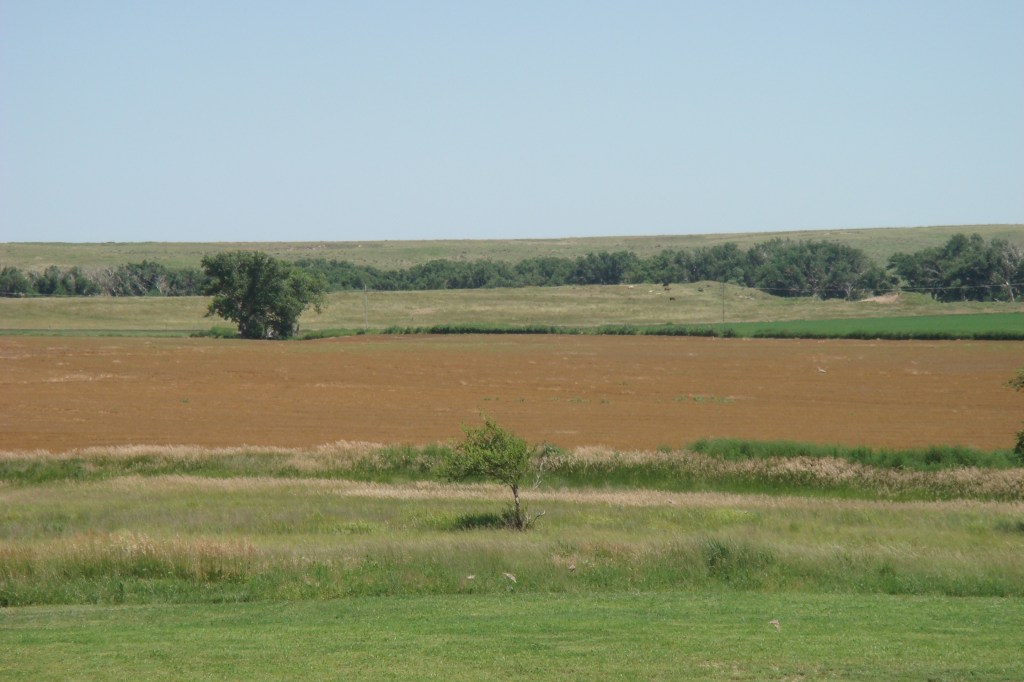
You can take a piece of something intoxicatingly boring and mundane and give it that creative flare. I call it “dressing it up”. Take the pictures above for example. Yes, I agree. They go on forever, or so it appears. Some would see beauty in them; some would see lack of an appeal. I see both actually. I didn’t grow up in an environment such as this, so the vast open plains give me a sense of beauty and allure. But there isn’t a whole lot to them. They’re just a road that goes on for miles, some hills, a sparse amount of trees, grass, and sky.

Now, take these same views, turn out the sun, and watch the stars come out. Now that is truly jaw dropping. Here there are no city lights to drown out the night’s sky. Here it is pitch black outside at night. You can get a blanket, lay it out, lay down and gaze up at the stars for hours. Better yet, the moon. I once saw a harvest moon out in the open like this. I was driving at night on I-70 through the state of Kansas. I looked out my driver side window and saw the biggest moon I’ve ever seen in my life. Talk about spectacular. I wanted to reach out and grab it, it was so huge and close.

In writing, we want to capture these beautiful scenes on paper. We want to capture the boring ones too. Either way, we writers can spice it up if it’s lacking or keep it as is. That’s one of the things I love about writing. We create and it’s anything goes. If your imagination sees it, your hand can write it (or type it).