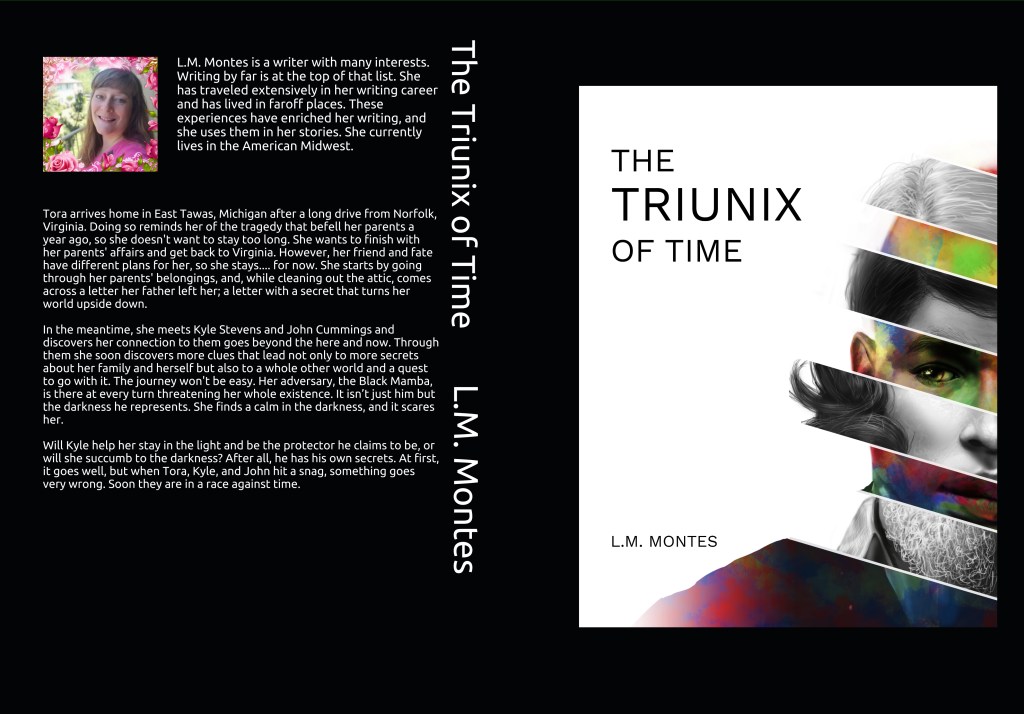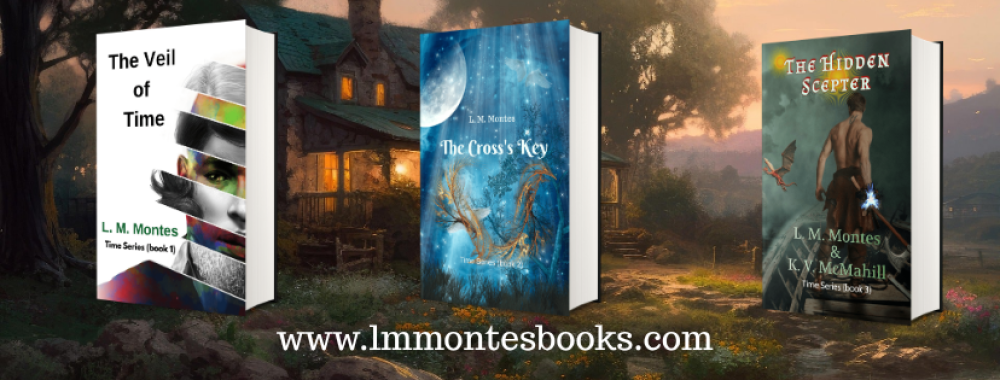
Coming in February, my novel, The Triunix of Time, will be on sale here on my blog. See details below.
Format: Paperback
Price: $12.50 – This is HALF OFF the regular price of $25.00 on Amazon.
Special Feature: Each book will be a signed copy.
Coming in February, my novel, The Triunix of Time, will be on sale here on my blog. See details below.
Format: Paperback
Price: $12.50 – This is HALF OFF the regular price of $25.00 on Amazon.
Special Feature: Each book will be a signed copy.


What inspires you? Is it a beach somewhere? Is it on a balcony overlooking palm trees and a beautiful garden? Is it on your couch at home in the comfort of your living room and your imagination? I’ve done my story writing at my kitchen table a few times, but truthfully, it’s difficult for me to be creative that way. I love being comfortable, so on my couch it is. If I’m writing while at a beach or outside at a park, I’d rather take my writing journal and put pen to paper. We all have our preferred modes of writing. What’s yours?
Another way to find inspiration is to use Pinterest. Yes, Pinterest. I do this. I have private boards for my fiction writing use. In each of these private boards I have sections for each type part of my story I’m working on.
These sections include:
For great information on how use Pinterest for your writing, click the 4:45 minute YouTube link below.
I would love to hear about what inspires you and what your favorite places to write are, so please feel free to comment.
According to Wikipedia, a character flaw (sometimes called a fatal flaw) is as follows:
Character flaw – Wikipediaen.wikipedia.org › wiki › Character flaw
In the creation and criticism of fictional works, a character flaw or heroic flaw is a bias, limitation, imperfection, problem, personality disorders, vices, phobia, prejudice, or deficiency present in a character who may be otherwise very functional.
How do you choose a character flaw for your main character? That is up to you. I centered it around the story. Once you choose a flaw, how do you use it within the story? Is it just there throughout and that’s all and the character goes about their business within the story and never learns anything from circumstances or their actions, etc? If that’s the case, do we even have a story? No. Not really.
The protagonist in your story is supposed to learn along the way. Their character flaw inhibits this at first, but gradually he/she comes to realize they need to change in order for their mission/goal/quest to succeed. By the end of the book they will have overcome this flaw.
Example:
Let’s say you have a main character named Molly, who’s in high school. Her flaw is that she’s timid/shy. She doesn’t like confrontation or violence and prefers to avoid it at all costs. She doesn’t like to hurt the feelings of others, so she avoids situations where she might have to speak up and maybe make people angry. Therefore, she doesn’t speak up for herself either. So, how does she learn to overcome this and become stronger inside? How does she get others to stop picking on her? How does she speak up for the truth and defend her friend Johnny?
In the above example, you have to get Molly from point A to point B to point C to point D; point D being the end of the story where she finally speaks up and gets over her shyness. Getting from one point to the next will involve a series of events called trials and errors that will serve as learning opportunities for her grow, but she can’t do this without these trials and errors.
We’ve all heard the mantra ‘write what you know’. Well, what do you know? You might get stuck here, and the reason I say this is because you may not think you know enough. Trust me when I say, you do. You have a whole lifetime of experience to use in your writing. You don’t necessarily need to know anything about any one thing in order to write what you know.
In my book The Triunix of Time I have lots of real life experiences included in the story. No, I’m not going to tell you which ones (LOL). There is also included in the story dialogue from conversations I had with others; snippets. Then, the icing on the cake, embellishment. Yes, use what you know and have fun fictionalizing it and building on it.
Here’s an example:
We’ve all had at least one favorite summer; maybe more than one. What made that summer your favorite? Maybe you spent it at the beach most often and you met a new friend, or maybe you spent two weeks of it with a cousin on a farm. Yes, lets use the farm experience. Cousins are a lot of fun. If you have cousins, and I’m sure you do, you know what I’m talking about here. Let’s say you want to write a mystery, but you don’t know what to use as it pertains to setting, characters, etc. Use your experience with your cousins on their farm. Let’s say you and your cousin found a wallet in the barn while cleaning the stalls. It ended up being your uncle’s wallet. Let’s fictionalize that a bit. Maybe you and your cousins were in your early teens. Write a YA mystery involving a bag of wallets you found in a hay loft in a small barn you were both told to stay out of. You were caught by your uncle’s friend when he walked in and heard someone up in the loft. You and Johnny in your haste put the bag of wallets back in a rush and call out. “Just getting some hay for the horses’ stalls.” And on the story would go. Do you see how you could create something wonderful from one experience? By the way, feel free to steal this idea.

Tora is a headstrong career driven woman who sets out to find the truth about her parents and discovers a family secret that goes back to the Magi. #WritingCommunity #amwriting #5amwritersclub #story https://www.instagram.com/tv/B_VZn8cHRmi/?igshid=xs2v2u2qv6c9
In a previous article I wrote about creating characters for your story. I mentioned in that article that your characters must be as unique as possible. I also illustrated two lists of characteristics a writer can use to create characters. I am going to list them again here as a reference for you. There is a good reason, I promise.
Digging Deeper
My goal in this article is to discuss HOW to use these traits to make your characters memorable and standout; to make them real. First, it’s one thing to describe in a story what a character’s traits are. It’s quite another to put this description to action. See examples below.
eg. 1. John had brown hair and blue eyes.
eg. 2. John swept his fingers through his brown, sweaty hair. He had been running the better part of an hour. His breathing labored, so he bent forward, leaning his hands on his knees. He blinked his blue eyes as sweat seeped into them. No matter though. The runners high is what he strove for, and he accomplished that.
As you can understand, example 2 gives a clearer picture of John. It makes him stand out as a human because we “see” him, and we come to know that he enjoys the sport of running. We readers can identify with him and how he’s feeling. Here is another quick example. Say your main character has a habit of cracking his/her knuckles. Don’t just mention in the story that they do this. Use this habit in an action. Maybe he/she cracks their knuckles when their nervous, or maybe it helps them think more clearly. Hey, you never know.
Another way we can use character traits to make characters real is to make one of those traits part of the story itself. Take religious beliefs for example. Maybe your story is about two people who are at odds with each other because of their religious beliefs. In the end they make it work somehow. Or, your main character may have a unique sense of humor. Work this into the plot. Use it to distract the antagonist at some point. Again, you never know.
Lastly, I’d like to hit on character flaw. THIS is a trait that every protagonist (and antagonist) must have. It’s what moves your main character forward and helps with their inner growth. I’m referring to the character arch here. The protagonist could have a character flaw such as being severely stubborn, to the point that their stubborness gets in the way of them accomplishing their goals. Yes, your MC will learn how to overcome this by the end of the story (that topic is for another blog post). BUT, it also makes them more real, allowing he/she to stand out.
In closing, how well we depict our characters in our stories depends on how we use their information to their advantage. Rich, well “seen” story people will give your reader a reason to come back to the story and want more. So, let’s give them something they will never forget.
(How many of you can relate to a story like this?)
I laughed at the comedy on TV. It was welcoming because I hadn’t gotten into a program in a long time.
Work, crafts, writing, they all had taken my time lately. But that’s ok. I’d rather do those things than spend all of my time watching television. A good brain workout doing other things than TV was better anyway. Then it happened.
The brown, hairy, eight legged thing revealed itself as I threw my head back in laughter once again. Damn, there was always something that had to spoil the fun. And just when no one else was here to kill it for me. I pursed my lips together wondering how I was going to do this. The way I saw it, I had one of two choices. I could sit and stare at it until my husband got home…….six hours from now, or I could face this and get it myself. Neither option appealed to me. Of all the places it could be, the ceiling. The only choice I had was the fly swatter.
With the fly swatter in hand, I steadied it below where said spider was. I was still too short. Damn! I trudged over to the step stool and placed it just to the right of where that ugly thing sat. I stepped up. Now I was too close. I shot out a breath. “Well, this has to be done for my own peace of mind.” I looked up and hunkered down out of its way just in case it fell. I didn’t want it dropping on me. Steadying the fly swatter just below the spider, I paused. Then, smack. But, instead of pulling the fly swatter away, I left it there, moving it back and forth to make sure I had killed it.
I stepped down off the stool and released the fly swatter at the same time. Peering down at the brown blob on top of it, I breathed a sigh of relief.
Story setting is essential. It’s one of the elements that pulls readers into the story and places them there. Can you imagine what reading a story would be like if there wasn’t any description of the places in it? Flat, that’s what it would be….flat. I would cast it aside in a heartbeat.
How do we paint a picture of what we want our readers to see when they read your story? It really is up to the writer. I say this because we’re all different and have our own ways of doing things. So, take what you will from this post and make it yours. I like to create my settings in such a way, so that when someone reads it, it sounds natural. What I don’t want is for the action/story to stop so that I can describe something. Doing that takes away from the story. Note the two examples below.
Example 1: Laural stepped into the room with her bare feet. The room was white with plush carpet. White curtains hung on the windows and blew in the breeze. To the right of the window sat a small square table with a bright green tablecloth. In spite of the brightness of the room, she should have felt comforted, but no. There was an eeriness that made her feel uneasy. A lock of her blond hair fell forward and she moved to push it back. She stopped midway as she felt his finger along her cheek.
Example 2: Laural stepped into the white room. Now barefoot, she stepped onto the plush, white carpet. At one time this feeling would have comforted her, but today the cushion of the carpet only served to increase that eerie sensation twisting in her gut. White curtains billowed as the breeze from the open window whispered into the room. Again, a false sense of comfort played in her gut. It were as though the room was dark, not light. The only color in the room came from a plant sitting on a small square end table to the right of the open window. A single black rose stood dead center of a plant whose bright green heart shaped leaves came to thin tips. His calling card. A lock of blond hair pushed forward over her right shoulder. Moving her hand up to push it out of the way, she froze midway as his finger caressed her cheek. Her breath caught in her chest. She wanted to run, but her legs wouldn’t move.
“You look pale, my sweet,” he said.
In the first example the setting description does nothing to move the story along and it doesn’t create any kind of feeling either. We are told that Laural is feeling uneasy, but the description doesn’t heighten this feeling at all.
The second example combines description of the room with how Laural is feeling, which in turn goes along with the story.
When you’re writing, and get stuck on how to describe something, sit back and relax. Close your eyes and picture your setting or situation. Then, when you’re ready, describe it simply. When you’re done with that, embellish it to fit the story/scene. It takes practice.
Tora is a headstrong career driven woman who sets out to find the truth about her parents and discovers a family secret going back to the Magi. What is this secret?