Blog Feed

Posted in Writing

Write It Down

You want to write a novel, but you don’t know how to start. You have all these ideas milling around in your head, but you can’t seem to organize them. What do you do? Write them down. Get a journal and write it in there, or create an electronic file in your word processing program and write it in there.

What do you do once you get your ideas written down and organized? This is where I say, it all depends on how you as an individual go about it? Everyone is different and will do what is comfortable for them. But what if you don’t know how you work? You are going to have to try different things and discover what way you like best.

Here’s what I do. When I finished my first novel, I immediately wanted to write the second one. I had an idea of what I wanted the second book to be about but most of it was bunched in my head in pieces. I knew what I wanted the story to consist of but I didn’t know what I needed to do to connect those ideas. I started out by putting together a three ring binder with sections. These sections are as follows: characters, realms, settings, photos, names for characters, questions, story, style sheet, and fantasy characters.

I went through each section of my binder and added my notes in each section. Once the information was separate this way, my mind was free to meditate on each. The one section I started with was questions. I looked at those and sought to answer them. No, the answers didn’t come right away. I brainstormed the answers and some questions I had to really think about. This is where my walks came in handy. During that time my brain was free to think. Much of what I came up with and worked for my story came from that thinking time during my walks.

Example: below is a question I needed an answer to for my up and coming novel The Cross’s Key. I wanted seven realms in my novel hence the double question below…..

What will these realms be and how will I connect them to the story?

The answer to the above questions did not come right away. It took a while. That’s ok. Don’t rush your story. Take your time. But…..write down your ideas.

Posted in Poetry

The Rain by L. M. Montes

I lay aloft on feathers
in a house of wood in trees,
the rain, oh sleep persuader,
carry the mind afloat on seas,
to slumber as I lay buoyant,
relaxed among the breeze,
trickle patterns of pitter patter,
to dreams my eyes will see.

Posted in Books

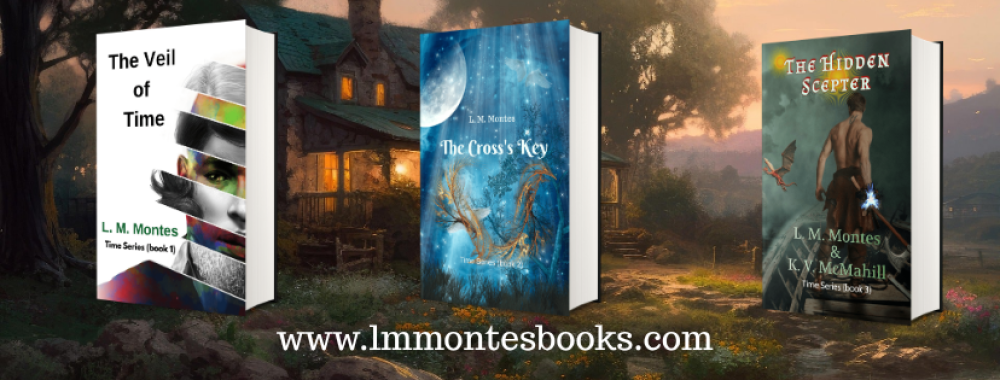
The Cross’s Key

Time Series book 2
Posted in Poetry

Podcast of The Fleeting Soul by L. M. Montes

Posted in Editing

Tightened Language

When you are writing a story, whether a book length story or a short story, be as clear in your language use as you can. Get rid of redundancies and use of too many words to tell or describe something, when a few words will suffice.

Too Wordy: Joe walked as slow as he possibly could on purpose because he knew it would make me angry.
Cleaned Up: Joe trudged down the path. He knew it would irritate me.

In the first sentence too many words are used to say what one word can do. By using the word trudge, we get a clearer picture of how slow Joe is walking without the extras. Then breaking it down into two sentences makes it easier to read.

Too Redundant and Excessive Language: The quarrelling couple downstairs worked my last nerve, I thought. The whole situation was making me angry to the point I wanted to go down stairs and tell them to stop.
Tightened Up: The quarrelling couple downstairs worked my last nerve. Hmm, maybe I’ll pound on their door and tell them to stop.

In the first sentence we don’t need the words I thought because we already know the character is thinking the words we just read. It’s one of those unwritten understandings. The reader just knows. That is what’s called excessive language. We also have redundant language in that sentence. The reader already knows the character is angry so the words, The whole situation was making me angry to the point…, is not needed.

Posted in Reblogs

Is it Creative Writing? — Emotional Shadows

This post is inspired from some books, which I’ve read or dropped half-way recently.  I’ve been wondering when did this happen: A marked erosion of language in modern fiction and deteriorating standards of vocabulary. When I was a youngster, there was a striking difference between good literature and cheap novels and the students of literature […]

Is it Creative Writing? — Emotional Shadows
Posted in Poetry

The Fleeting Soul by L. M. Montes

In life you are a soul behind a mask,
hiding from the world but yet you seek
true beauty from within a natural set,
displaying gold inside your heart,
giving what you have to all, then part.

In dreams you linger strong and within sight,
but then you move and vanish from my
reach when hands behold your presence,
leaving one to wonder if you are there,
or staying away forever, ’cause you care.

Posted in Poetry

Nature’s Movement by L. M. Montes

Falling beams of sun’s pure light,
portrayed the morning’s breath
of flowers and scented dew,
a haven and dreamlike world
to ponder thus with you.

In nature’s quietness I sit
upon a grassy cliff up high,
a tree it tapped me on the head
as breezes they set sail
and spoke of change’s rule.


Posted in Poetry

Life’s Choices by L. M. Montes

The pull of life reached out to me,
and taunted with its symmetry,
so many shapes and paths that call,
which one to do or none at all,
alas I chose and it was wrong,
so others harped with nasty song,
inside I shrank and bent to cringe,
the edges of my mind so singed,
but light it came and slayed the burn,
as from mistakes the brain it learned.

Posted in Poetry

The Sonnet

A true sonnet contains the following:

  1. 14 lines
  2. Each line is written in iambic pentameter. This means that there are 5 feet per line. In each foot there is one unstressed and one stressed syllable for a total of 10 syllables. If your sonnet has only 9 syllables in one or more lines, it is NOT in true sonnet form.
  3. A rhyme scheme. Choose from one of many rhyme schemes and stick to that rhyme scheme throughout your sonnet. (See my post from July 22, 2022 entitled Rhyme Schemes)

I once read a poem by someone who said it was a sonnet. Well, at least five of the 14 lines had only 9 syllables, so it wasn’t written in iambic pentameter, and it didn’t follow a rhyme scheme.

People complemented the writer of the poem by telling that person how great a sonnet it was. Well, it wasn’t a sonnet. It was a beautiful poem with lots of meaning, but it wasn’t a sonnet.

Sonnets can be tricky to write, and they take time, given everything that goes into them. What I do is get the iambic beat in my head as I’m writing a sonnet. This beat goes something like this:

Line 1: ta da’ ta da’ ta da’ ta da’ ta da’

In the above line 1 example, each ta da’ is a foot. Notice there are only 5 of them, no more no less. The tick mark after each da’ means that the accent is placed on that syllable. Here is another way to look at it. Let’s put some actual words to the Line 1 example above. Each word or part of a word that is in all caps is the syllable that receives the stress.

Line 1: When SNOW has COME and LINgered FOR a TIME,

Make sure your lines follow a rhyme scheme.

Rhyme Scheme Examples:

Petrarchan: also know as Italian. abba abba cde cde OR abba abba cdc dcd

Here is how it will look in line form:
Line 1: a
Line 2: b
Line 3: b
Line 4: a

In other words, Line 4 will have the same end rhyme as Line 1. And Line 3 will have the same end rhyme as Line 2. For Lines 5, 6, 7, and 8, you would follow the same rhyme as you have for Lines 1, 2, 3, and 4. Again, for my article on rhyme schemes, see my post entitled Rhyme Schemes dated July 22, 2022.

Take your time and don’t rush when writing a sonnet. When you’re finished with it, go through each line again by reading it and counting the syllables to make sure you have 10. Also, make sure you have 14 lines and follow a rhyme scheme. For more information on writing sonnets, click the link below.

https://nosweatshakespeare.com/sonnets/how-to-write-a-sonnet/