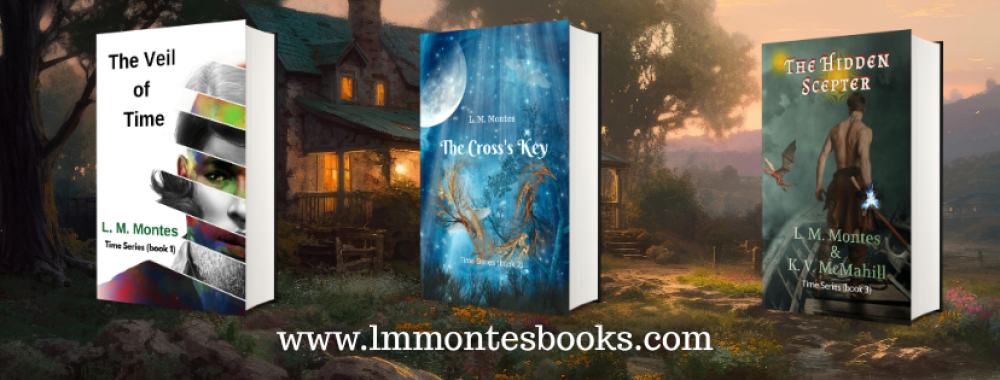
If you are an author, whether you are experienced or not, sometimes talking to someone you trust (implicitly) about your story ideas can help you tremendously. I know that’s very simple advice, and maybe you already knew that. But it’s a good reminder. I never would have come up with the story I did for my first book had I not confided in my creative writing professor. Sometimes we need that nudge. So, if you are on the fence about a piece of writing you are working on, hash it out with a trusted friend.
Author: L. M. Montes
Hi There!
Welcome to my site, and thank you for visiting. Please feel free to share this blog and any posts herein.
Hanging by His Hand by L. M. Montes
The present is but a wave
creeping toward the shore,
then in a breath it’s gone–
backwards evermore.
In life our friends and family,
warm our hearts and stay,
in our minds and in our soul,
then gone to our dismay.
Time’s wind blows at vicious speeds,
our memories we take hold,
that is all we have one day,
when we are growing old.
Alone we feel when most are gone,
as to the grave they go,
where does one lean in nothingness,
no one is there, you know.
But Christ is here and looking down,
and sees our pain that stands,
His love surrounds and comforts,
as you’re hanging by His hand.
by L. M. Montes
Find Me Also on Patreon
Wilderness by L. M. Montes
In the vast array of wild I shrank
with no one else about,
am I the only one on earth
or separate, taken out.
Foliage crunched as footsteps sank
in leaves of dry dead beds,
where is water for me to drink,
a pounding slams my head.
A distant creek spoke in bubbles
leading my ear to treat my tongue,
dragging feet and limbs in slump
I flopped in waters that sung.
The Villain Makes the Story
Have you ever wondered what a story/movie would be like if there were no clashing forces going against the main character? It would be boring to the point there would be no story. Not really anyway. Believe it or not villains create that extra zing of emotion for the reader/viewer to the point we sometimes feel as though we’re in the story/movie.
I finished reading a book a few days ago that had me talking back to the characters, and I mean saying things like, “Really? Don’t you see it has nothing to do with terrorism?” At one point I said, “Oh my gosh, this author.” My husband asked, “What?” To which I responded with, “The author drug this out way to much.” Actually, the author did his job, and he did it well. The villains were smug, very smug, and they thought they had everything going the way they wanted it to. Well, they did. The reader (this reader) wanted them to get what was coming to them (and they did eventually). That folks is story, suspense, emotion building writing.
So remember….when you are creating your villains, make sure to give them lots of tender loving care. You want them to connect with the reader too.
The book I spoke of above is linked below just in case you might want to read it. It’s book 5 in the Alton Blackwell Files series by Steven F. Freeman.
Character Names
How do you choose names for your characters? Do you merely assign them a name without giving much thought to it? Do you use a process? There are quite a few things one can do to assign names to their characters. I’ve used a baby names book. Looking names lists online works too. If your character is of another culture or country whose names are different than those used in your own, some baby names books have lists of common names used in different countries.
In one of my pieces of writing I used characters of 4 real life people. I asked them permission first. Please, if you are ever going to do this, ask that person or persons permission to use them in your book/story. When I was renaming these 4 people for my story, I tried to choose names that fit their personalities. Trust me, this wasn’t as easy as it may have appeared to be. One gentleman helped me with that, so that one was easy enough to put a name to. The other three took some thinking. I got my baby names book out and browsed male names. I thought of each person individually and then tried out a name on them. I went through several before settling on some that worked well and matched each of their personalities. There was only one problem. One of the guys I couldn’t think of a name for. At all. So I, for the time being, left his name alone and used his real name until I could think of one that suited him. FINALLY, after writing 25 chapters, I thought of the perfect name for him. Of course, I had to go back and change his name throughout the manuscript, but it was worth the wait.
Most often you’re not going to use real people. But the same thing still rings true. The people you make up will have personalities and you will have to choose a name that fits that personality. Also, if you are going to assign a name to a character that sounds funny or out of place, you might want to explain why they were given that name by making that part of your story. For example, if you give one of your female characters the name of Spunky Dickson (a funny name for a female anyway), have the character tell why her parents named her that. Maybe the whole story centers around that. Maybe Spunky is a nickname.
Have fun choosing names for your characters. Don’t make it a chore. Work with it and mold it into your story.
Invisible Love by L. M. Montes
How are you, I wonder, you I never see,
are you here or are you yonder, with me you’ll never be.
In my mind you live, you touch, I never feel,
will you ever hover much in dreams where love is sealed.
Once we were together,
where friendship we endured,
that is all it ever was,
a gift so gentle and pure.
Life’s Tides by L. M. Montes
Life’s tides sneak unseen
as meditations meld my mind,
passive, I remain,
a wind’s breeze feathers a scent
of sweet roses, walking by,
yet passive to the tides
of life as they wave good bye.
Goodness by L. M. Montes
Issues spatter all around,
leaving a mind struck, not sound,
tis a guide to dullness feed,
for goodness one does want and need,
hoe the dirt and human weeds
and find the sprouts of mustard seeds
lifting tall and growing delight,
a faith in all that’s good and bright.
Beginning a Scene (Part II)
I posted on October 22, 2021 an article about beginning a scene with action. Continuing that, we move to beginning a scene by creating a question in the reader’s mind. This doesn’t mean the author asks a question in the first paragraph. All it means is the situation at the beginning of the scene is done in such a way that the reader must continue reading in order to find the answer to what the information at the beginning of the scene is hinting. See the example below.
Example
Dan did a double take as he glanced up at two women, a blond and a redhead, entering the club. He’d seen the blond female before but couldn’t place her. Maybe she was only a face in the crowd. A nudge on his right shoulder interrupted his thoughts.
“Hey,” said Dwayne with growing impatience. “You join in the rest of the gang or what?”
“Yeah, yeah.” Dan turned back to the two women, but they’d disappeared. Shooting a glance in each direction proved fruitless. He ran outside and peered in each direction to no avail.
The rest of the evening, though full of laughter all around, continued to plague him as his thoughts returned to the blond.
The reader is left with a couple of questions:
1. Who is the blond woman?
2. Why is she so important?
There is enticement here. One wants to continue reading to find out who she is and what is the situation behind his familiarity of her. No action is really needed here. Although, one could easily add some to increase the velocity of the story pace.

