Create your setting by way of your narrator’s Point of View. Doing this will also instill feeling into your fictitious place. When that happens, your readers will feel it too, and that’s what you want. It keeps them reading.
Tag: Fiction
Writing Growth

Your growth as a writer is important. After all, the better you get, the better your story/poem will be. When that happens, your reader response goes up. You also want to please others with your writing and getting better at it will accomplish that. Below are some ways to advance your writing skilks:
- Write Everyday: You might not feel like writing everyday, but if you write something…anything for just 5 to 10 minutes, it’s still something. Oftentimes, that 5 to 10 minutes turns out to be longer without you realizing it. What writing everyday is doing is getting you into a habit. Great! That’s what you want.
- Use Writing Prompts: These are particularly useful when you don’t know what to write about. Plus, if you don’t feel like writing, it’s a great way to get you writing something. Keep in mind, 1 prompt can be used for a number of different stories/poems. The internet is full of writing promt list. Just type that into Google Search
- Get Feedback: I know, no one likes to be told they need improvement. We all enjoy hearing how good we are. BUT…hearing how you can improve will raise you to that next level.
- Read from the Best: Read works from some of the best authors you enjoy reading. Do not copy them, but learn from their stylistic choices. Then use what you learn to improve YOUR style.
- Take Classes/Courses: Talk about beneficial. This is an opportunity for you to ask questions and sharpen your skills as a writer in a more in depth manner.
- Read Books about Writing: There are so many books out there on the subject of writing. Whether you are writing fiction, non-fiction, or poetry, you can find books on the different aspects that go into each. From story structure to learning how to incorporate emotions into your characters. These books will help you. Some of them even have exercises so you can practice.
Have fun with your writing growth journey. I promise you it will be a great adventure in and of itself.
The Story Within
Everyone has a story within themselves. One that’s either dying to get out or one that wants to stay hidden. If you decide to tell your story, tell it. If you want it to remain hidden then do that. But there are two ways to let it stay hidden. You could leave it alone and do nothing at all, or you could tell it but weave it with fiction. No one will ever know. You will know, but no one else will. That is the beauty of fiction.
Pretend
Have you ever played pretend when you were a kid? If so, shuffle through your mental library of pretend scenarios and expand it into a story. This could be a short story or novel. Just an idea in case you need something to write about.
Romance
Maybe you had a romance that ended on a bad note. You would like to write about that, but you don’t want anyone to know. Well, who has to know it was your experience?
Trouble
Maybe you or someone you know got into some trouble. Ohhhh the intrigue that could come from a story such as this. Embellish and expand on it. Create a fictional detective series that centers around it.
Whatever stories lie within that computer bank living inside of your head, use them if you’re so inclined. That is, if you enjoy the art of writing. If not, leave them alone.
Plot Holes

Have you ever read a short story or a novel and somewhere along the way the story/plot didn’t make any sense? It felt as though information was missing, or there was a lack of consistency. The result of all that is you scratching your head in wonder, putting the book down, or leafing back through previously read parts to see what you missed.
That gets too distracting. So how do you as the writer avoid making those same mistakes as a writer? In your own writing, some of the inconsistencies you may be aware of and some you may not be. For the ones you know of, write them down in a plot holes log. For the ones you are not aware of, you will catch those later in your editing.
To expand on this, here is what I do. In the writing software I use, Scrivener (You can find it at Literatureandlatte.com), I create an extra file labeled Edits. Within that file folder I have various files for the different types of editing I will do later. One of those files is called Plot Holes. When I know of a plot hole that I need to address later, I write it there. When I am finished with my manuscript later, one of the things I do is go to that list and fix those plot holes one by one. THEN I start reading my manuscript from page one and go straight through to the end. Along the way I am searching for any more plot holes I may have missed. I make note of them in the manuscript with my red pen and move on. When I get to the end of the manuscript, I go back to those plot holes I made note of in red pen and fix those. Please note…..when I am reading for plot holes like this, plot holes are the only things I am searching for as I am reading. DO NOT fix anything else or make note of anything else during this process because you will lose track of what you’re doing, and you don’t want to start over. If you have to stop to run an errand or cook dinner or something, mark your spot and go back to it later. Trust me, this is the process I used and it served me well.
Reaction
You’re writing a scene with an event that should strike your main character as surprising or distressing. BUT instead your character reacts in a way that makes no sense at all. Maybe you had your character have to shoot an intruder and it was the first time they had to shoot anyone. How would a person normally react in a situation like that, if it was their first time having to shoot someone?
Make sure your character who is going through that for the first time reacts the right way. If, for example, they walked away from the above situation behaving as though it was no big deal, then there better be a logical reason for them doing so. I say this because I know I would freak out if I had to shoot someone. Or I’d panic. Maybe others would become despondent or go into shock.
If your characters’ reactions don’t match the situation, the readers will know, and they’ll get distracted from the story. You don’t want that. It could even cause them to put it down, and you definitely don’t want that.
Goals
If you are serious about writing a novel, novella, a book of short stories or poems; create a goal for yourself for each day. They say in order to create a habit, one must do the same thing for 21 days (maybe longer depending on the individual). Write everyday and hit the goal you set for yourself. Eventually, sitting down to write will become second nature.
However, it’s tough sitting down to a blank screen because, when this happens, many times the mind goes blank as well. Help your mind out by creating some stimulation for it. Again, we’re all different, so the type of stimulation will be different for everyone. Maybe music will get your mind going, or even the television in the background. Whatever works for you. Or, just start writing what comes to mind. This gets those wheels turning as well. Before you know it your fingers will be flying across the keyboard.
Habits and Mannerisms
What can you do to make your characters stand out as individuals? Well, there are quite a bit of strategies you can try, but two of the most popular ones to try are to give you characters habits and certain mannerisms. Think outside the box with this. Get creative. I say this because, one of the things you want to avoid is making your characters like everyone else.
Example:
Maybe you have a character who, when they are deep in thought, not only creases their brows together, but they also place a hand on their hip and scratch their cheek with the other at the same time. Then they lean on their other hip, place their opposite hand on that hip and scratch their other cheek with their other hand.
Yes, one would normally call this fidgeting, but it is very specific and the reader gets to see just how they fidget. The details of these movements causes this character to stand out. That’s what you want.
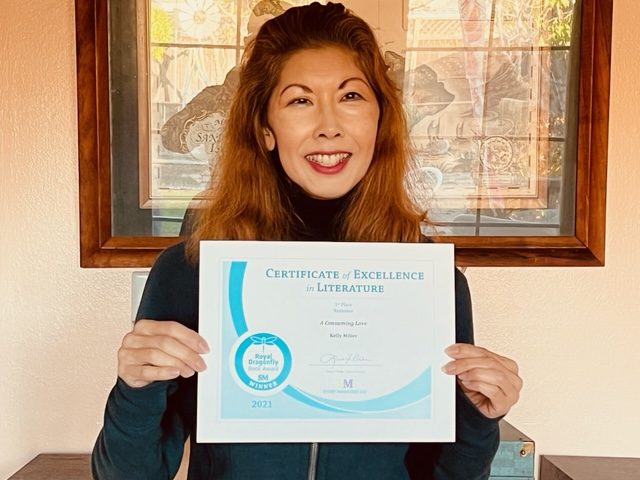
Congratulations to Author Kelly Miller
“A Consuming Love,” a “Pride & Prejudice” by author Kelly Miller #Regency #Romance has won 1st Place, Romance, Royal Dragonfly Book Awards!
Well done, Kelly. Many congratulations to you. We look forward to more great reads from you in the future.
At Audible! Free on KU!
https://t.co/aGfVR9Ql8m
Endurance

Any of you out there who are long distance runners know that, when it comes to running, it takes endurance. You run until you reach your goal and you don’t stop. I’m not a long distance runner, but I have run distances up to 3 miles. Yes, there were times I wanted to stop. What I did was play mind games with myself by saying I’ll stop at the next corner. Then I would keep going at the next corner and say ‘ok, the next telephone pole I’ll stop’. Again, I’d keep going. I would do this all the way to the end. Eventually, I wouldn’t need to play these little games with myself because my body would get used to it.
The same thing goes for writing a novel. There are times you want to stop before you reach your goal of whatever word count you promised yourself you would write that day. So, you play a mind game. Let’s say you fixed yourself a goal of writing 1000 words everyday starting Monday. Monday comes and you are 500 words into your writing and you want to stop. You tell yourself, ‘ok, I can write 100 more words and I’ll stop.’ You accomplish this, except now when you reach the 600 word mark, you can’t stop because you’re on a roll. You keep going. All at once you look at your word count number and you have 1200 words. YAY!!! You went over your goal. Does this happen every time? No. If you find you just can not think of anything past the 500 word mark, then stop and come back to it later that day. Who said you have to write 1000 words in one sitting? As long as you reach your goal by the end of that day.
There will be down time when you need time to think about your story and what should come next. I call this ‘Planning Time’. So…plan away. I consider my walks as part of my planning time because it gives me time to relax and think about my story. Much can come from one’s brain when they relax. Another thing that will help keep up your writing endurance is by talking about your story with someone else. My daughter helps me with that. Let me tell you…it helps in a BIG way.
Writing your novel doesn’t have to be a chore, so make it fun. Run those fingers across the keyboard or your pencil across the paper. Let your brain run in several different directions as it thinks of new ideas for your story. Endure. You can do it.
Point of View: Which to Choose
On October 16, 2021 I wrote an article that talked about the various points of view in which a story teller can use to tell a story. I talked about the following points of view.
- First Person POV
- Third Person POV
- Third Person Omniscient
- Third Person Limited
- Third Person Objective
(Please refer to that article for details regarding each one) The purpose of this short article is to talk about which one should you choose. Very simply put, it’s up to you the writer. Which one will tell your story better? Well, to know this, you have to write your story in each of the points of view. That is, if you’re undecided upon which one to pick. After you’ve written your story in each point of view, read each one aloud. Doing this will give you a feel for which one suits your story more.

