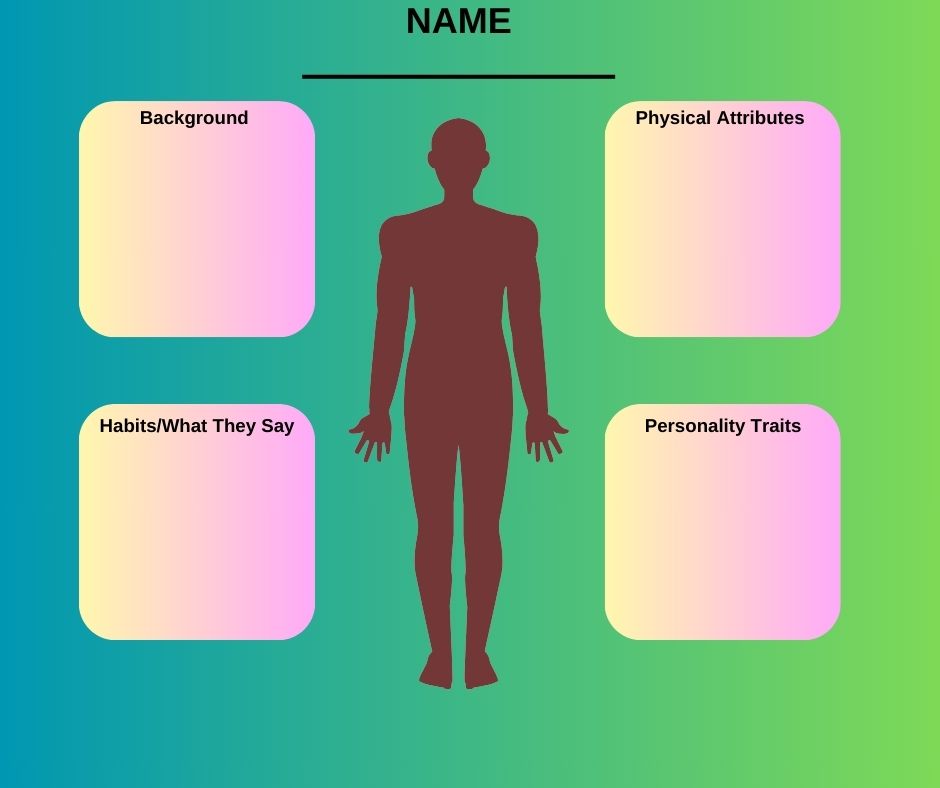
Think of your main character as you would a lump of clay. At first that’s all they are, someone ready for molding and maneuvering into whoever you want them to be. People are complex, so there is much information that goes into creating them. First think of the different types of qualities, traits, and information needed for a character’s creation. Then break that information down into categorical blocks. Then fill in each block with the type of information assigned to it. Please see the example below.
If you’ve chosen to be a writer, whether it’s fiction or non-fiction, you will see quite a few books and articles regarding the do’s and don’ts if you want to be successful. I’m here to tell you there is no hard and fast rule you must follow to be a definite success. What I will tell you is to read what others have tried in the past and try it. If it works for you, continue using it. If not, either tweak it to your liking or stop using it. We are all different writers with different writing styles. What works for one writer will not work for another.
Example: Characterization Some writers like to make a detailed personality sketch of their characters. This is a great idea because you can use it to refer back to, while writing your story. Does every author/writer have to do this in order to create great characters that come alive and stand out? Certainly not. You might be the writer/author who would prefer to make a video about your character. How you do this is up to you, of course. Or, you might make it up as you go along. Hey, whatever works for you and creates memorable characters.
Don’t stress yourself out by trying to write how others write and whether or not you’re getting it just right. Use their strategies, but use them in YOUR OWN way.
In reality we all go through our own personal growth. It’s called life. In a story our main characters go through their own personal growth. It’s called a character arc. With all of the mistakes we make, most of us learn from them and move on to the right path. Along the way we hit another snag, we learn (hopefully), and continue on. Because we learned our lessons from the past, if we’re hit with the same situation again, we’ll know how to handle it the right way. We grow from our experiences.
But here’s the thing. Our lessons in real time are learned over the course of a lifetime, which can be years. In a book the character arc for the main character progresses for the life of the story/book. Think of it of as a cycle of sorts or a path. The character starts out at point A then moves to point B by way of various experiences, conflicts, decisions, and mistakes. From point B they move forward using what they learned to get to point C. They go through more challenges and are faced with more fears. Then they reach point D. By the end of the book they’ve gone through some changes personally and overcame their fatal flaw. Growth. If your main character goes through each of the points in the character arc cycle without showing any kind of growth, there’s something wrong. There must be growth.
A character arc that has a fascinating and compelling character arc will have characters overcoming challenges and facing fears as the story unfolds. The outcome? Personal growth, much like how people in real life obtain personal growth.
If you are in the beginning stages of learning how to write fiction, DO NOT…I repeat… DO NOT inundate yourself with too much information at one time. You will get overwhelmed and risk putting out that learning “flame”. Take one topic, for example characterization, and learn a little about it each day. Take small bites. Trust me on this. Also, taking fiction writing class works just as well.
The years spent writing my first novel weren’t just spent writing. What I discovered early on was that I didn’t understand how to put a book length story together. To be specific, I needed to learn story structure. Thus, great care was taken to spend time learning about the craft of writing a book. Much trial and error occurred, and through all of that I discovered what worked and what didn’t work for me.
Other story elements I had to brush up more on were story flow, word flow, grammar, plot, character development, dialogue, character emotions, the list goes on and on. This all takes time, yes, but it is well worth it. While I was learning and brushing up on these skills, I wrote as well. There were times of frustration, when I had to delete part of my story and start over. But the more I wrote and learned, the easier the whole process became.
You won’t be the best straight out of the gate. No one ever is. But the more you learn and learn continuously, and practice what you learned, the better and easier it will become. So where do you start? Start with your weakness. What areas of writing and grammar are you weak in? Start there and move forward.
Now, two books later, the ride has become more fluent. The words flow more, and I know way more about story structure than I did years ago when I first started. This doesn’t mean there isn’t anything else to learn. I still continue to learn. Learning is what keeps us going and maturing and moving to the next level.
How many times have you been part of a group or team where there is at least one person who has to be a stickler for keeping things on track? They correct you if they feel you’re wrong, and/or make sure everything is done right. I think it’s a rule of life that every group has to have someone like this in their life in order to keep everyone on track whether it’s their job or not (I’m laughing here, because I know people like this). These people can (but not always) cause tension in your story. So if you want to spice things up a bit, included one of these types of characters within your story.
Have you ever read a book, and you liked the characters so much that you didn’t want the book to end? Oh yes, I’ve been down that road myself. That means the author did their job of creating characters that stand out and touch your heart. But, how did they do that?
Their characters displayed emotion to the point that the reader ‘felt’ right along with them.
The character displayed a habit or two. This personalizes the character, makes them human.
The character was relatable. We as a reader could identify with that character. We may have understood what they were experiencing. If not, then we could at least feel for them and/or root for them.
The dialogue sounded real and not mechanical or robotic. Maybe they made you laugh or cry.
These are just some of the elements a writer uses in order to bring a richness to their characters. Take your time developing them. Observe people around you and jot down notes of things you see or hear them say or do.




 WRITE TIME AND AGAIN