
Blog Feed


Appearance
Remember, not everything is what it appears to be. Just when you least expect it, the “curtain” can go up and things are then seen in the truest light.
Forgiveness

Forgiveness,
a symphony of music
freeing the soul,
A gift,
surpassing all others
because it comes from an enemy,
yet is heart felt.
When forgiveness doesn’t come or isn’t given,
the heart cries,
singing a song of anger, rage, and hatred.
Forgiveness,
a light,
guiding on a righteous path,
leading only to God.
A healing that cleanses,
washes,
so contamination is no longer a threat.
When forgiveness doesn’t come or isn’t given,
the light slowly dies along with the soul.
Forgiveness,
a freedom,
like the eagle taking flight above the clouds,
carried on the whip of the wind.
A rush of adrenaline,
knowing you have the potential to do all
that is right and good.
When forgiveness doesn’t come or isn’t given,
the wings break,
plummeting you to earth,
never to fly again.
Forgiveness,
a dove,
that lay in the heart and soul,
to rest,
bringing happiness within.
A sense of peace,
giving the knowledge that we
will be able to grow as
sweetly scented flowers in
the righteousness of God’s heavenly garden.
When forgiveness doesn’t come or isn’t given,
we flowers die,
becoming thorns among men.
Now,
I release unto you
the greatest gift,
that of forgiveness,
sitting on the wings of a dove
as it grants you peace,
flies you toward your freedom
down the path of light to your
Savior’s loving arms.
By L. M. Montes
Divine Death

Three men,
Hanging on a cross,
Two are sinners,
One is divine.
Oh Jesus on the cross,
This I ask of You,
Forgiveness and mercy
For my sins,
So I may be with You.
Death’s clutches take hold,
The devil he must fight,
The Son He is the victor,
Not just for me,
But everyone,
So we may rise to heights.
By L. M. Montes
The Apology

I sit and look up to the sky,
With heart felt tears within my eyes,
The clouds they float and pass away,
But will this hurt I have caused today?
The leaves they whither and fall to the ground,
Like my heart when this sadness mounds.
This rain and thunder I wish I could erase,
And wipe the pain from your sweet face.
But I can’t change what I have done,
Like the blowing wind the past is gone.
I can only offer this with every part,
And say I am sorry with all my heart.
by L. M. Montes
Evening

Twilight comes but once a day,
The sky turns raven black,
Grass and flowers yawn away.
Stars step out to blink and wink
While the moon man smiles back,
A look that only heaven thinks.
The tide rolls in to eat the sand,
While couples stroll along the beach,
Arm in arm or hand in hand.
by L. M. Montes
God’s Beauty by L. M. Montes
God’s beauty,
a wonder,
a secret never told,
vast majestic mountains
in its palace of white gold.
Oh you people in the valley
of the village down below,
roam in silence
always seeking
for the secret never told.
The mist that lightly lingers,
gently staggers wide white fingers,
through a dark collage of mountains
laying to rest upon the snow
to find the secret never told.
Presence by L. M. Montes

Look on sea blue skies and see
a dove that carries warmth from me.
Lie your weary soul on soft smooth sand,
close your eyes,
I’ll take your hand.
Smell the sweetness that painted flowers send,
and know the comfort to thee I do attend.
Listen, to the woosh of the waves,
hear my whispering words
that linger lightly as they say,
look at me,
across the vast expanse of time,
I am with you, in heart and in mind.
by L. M. Montes
Snippets

When you’re writing, whether it’s a short story, a novel, or a poem, do you pay attention to what is going on around you when you aren’t writing? Sometimes I’ll write down what I hear/see in my journal for later use and sometimes I don’t. Most times I remember. I know what you must be thinking. “How can you remember all that?” Well, I don’t. It isn’t until I’m writing a scene, and what I’m writing triggers a memory of something I saw or heard, then if it fits the scene, I use it. But, most often it’s only snippets of a conversation or something I saw that I end up using. Journals are a wonderful thing though and can contain a treasure trove of useful info. Take what you can from real life and mold it like clay.
The pictures below of are my journal for my novel The Triunix of Time. As you can see from the warn tabs and such, it’s been used quite a bit.

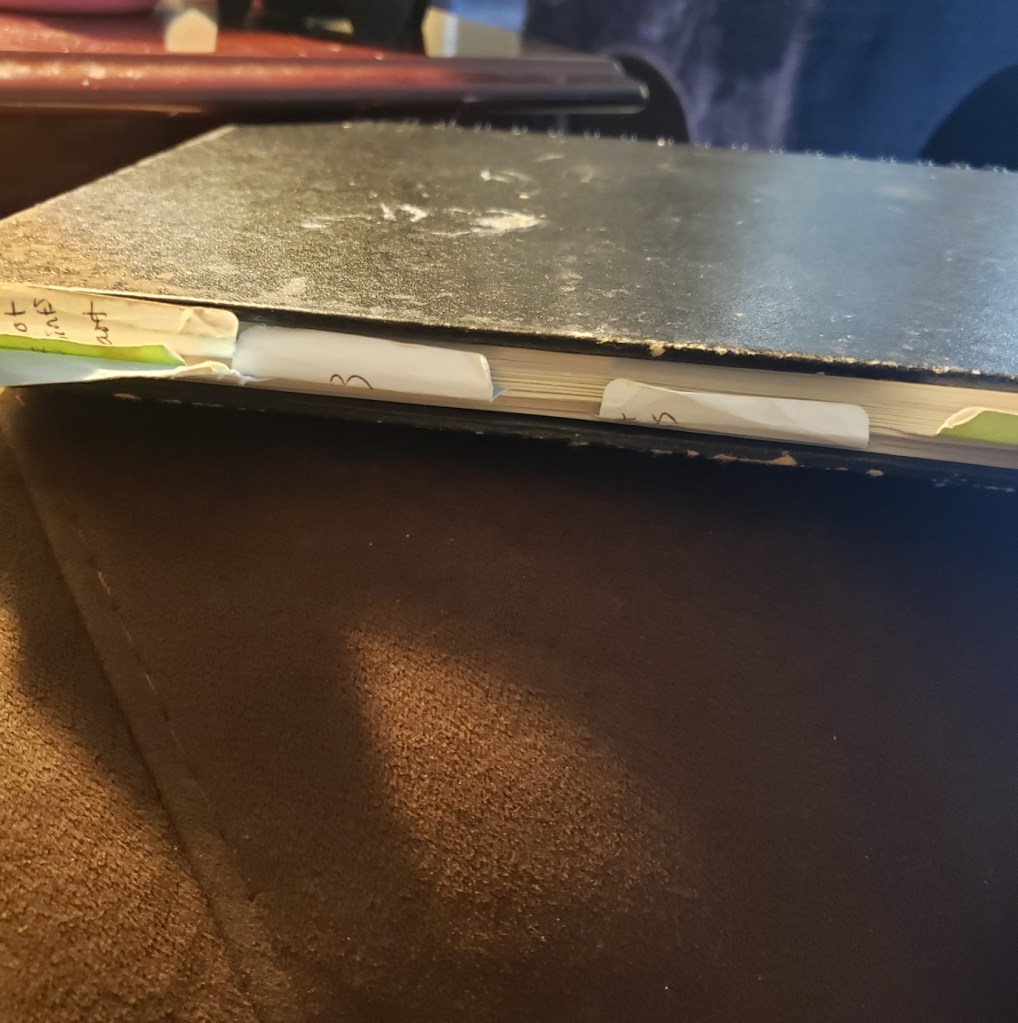
The Triunix of Time
Chapter 1
(Please enjoy the first chapter of my novel)
Tora drove straight through from Norfolk, Virginia where she lived. This trip was temporary. Quick in quick out. She would go through everything in her parents’ house, pitch and toss, fix what needed to be fixed and sell the place. Then, it would be back to Virginia. Michigan was still a welcome sight though, to a certain extent. But there were still ghosts to deal with as well. She wanted to be back home but dreaded it at the same time. Without her parents, it wouldn’t be the same. Thoughts of her mother came flooding back. Nothing Tora achieved was ever good enough. There was always something more she wanted from her daughter. Her dad was different. Always loving, always interested in what Tora did. This difference in affection for Tora between her mother and father plagued her. Now she’ll never know. Damn, why did her parents have to die? Why then, why at that time? It’s as if her mother planned it that way. Oh, but that was ridiculous.
She pulled into the driveway of her parents’ house. The two and a half story stood untouched. This house Tora once shared with her parents stood in silence in the afternoon sun. Facing east the house cast its shadows forward, lurking, as the sun pushed itself from the backyard. Tora parked her car near the front, stepped out and took in the fresh air. No breeze. Usually she enjoyed the late afternoon glow of the sun passing through the trees. Today was different. But why? she couldn’t shaker her unease.
Shrubs flanked either side of the front of the door and along the whole front of the house. The bird house Tora made when she was eight still hung from the large oak tree on the far end of the yard. The grass bragged a lush green today as usual. She strolled up the curved sidewalk taking in the fresh scent of June air and tried to smile. The house itself stood back from the road and was surrounded by woods. This and the peaceful landscape made for a relaxed atmosphere. She saw the gardens had been tended to. She would make to thank Mr. Lyons later. Now she needed to get settled.
Inside appeared to look the same, but the feel was all wrong. Whether it was the lack of her parents’ presence of something else entirely different she couldn’t tell. The arched entryway closed in around her. Suspicious, Tora walked through the large entry hall. This grand room that glowed any other time was dull now. The smoky rose carpet now dull. The silver trimmed staircase so grand before, so small now. She strolled into the living room and caressed the plush sofa cushion. The cuckoo clock whistled from the kitchen, startling her thoughts to that fateful day when she last saw her parents a year ago.
“What do you mean I was acting out?” asked Tora. “Acting out against what?”
“You know, back then you were only sixteen and didn’t really know how to show your feelings,” said Tora’s mother. “Your father and I were having some problems, and you decided to show us how you felt by acting out.”
Tora was dumbfounded and unable to believe what she was hearing. She felt like a teenager all over again even now at the age of thirty. Her mother wasn’t even listening to a word she said. But she had to make her understand, now that she fully understood that whole situation herself for the first time since it happened.
“Mom, you and dad were having problems?”
“Oh, now don’t act like you didn’t know.”
“No, I didn’t know. Look, that incident didn’t happen as a result of my acting out against you and dad. It happened because I was too young and immature to know how to handle the situation.”
“Tora, you were sitting at the picnic table with a glass of wine. You should have known not to drink it. You knew better, or at least I thought you did.”
“Yes, I did know, but I…”
“You see? You did it out of spite.”
“I didn’t say that. If you’ll listen to what I have to say.”
“Alright, go ahead. I’m listening.”
At that moment her father, Thomas Jasper, stuck his head inside the back door. “Hey, Kath. Come on. We have some figuring to do.”
“Wait a minute. I’m coming,” said Tora’s mother, a hint of irritation in her voice.
“He got that bottle of wine for me. At the time I knew I wasn’t supposed to drink, but I was afraid of what would happen if I didn’t, plus I didn’t want to hurt his feelings. I was sixteen and faced with a situation I didn’t know how to handle. Then, when you drove up to the campsite, I was hoping you would tell me to get in the car. At least then I wouldn’t have had to deal with the situation.”
“Oh please, Tora. You would have pitched a fit if I had told you to get in the car.”
“Didn’t you hear anything I said? Damn it, mom, it has been almost fourteen years and you still blame me for something I had no control over and didn’t know how to handle.”
There was so much her mother misunderstood about that whole thing. All Tora wanted was for her to really pay attention. She still felt her mother blamed her for what happened that day. What mother daughter closeness they did have, which wasn’t much, declined since then. Her trust in Tora was gone.
“You did have control over it, but you chose not to. Look, your father and I have to go. We’ll be late.”
“Mom, all I want is for you to listen, really listen, to what I have to say because you never really do. Instead, you take what you want to hear and twist it around to suit your purposes, and you’re using this incident in the campground as an excuse to further push me away. Our relationship has always been strained like this. Do you hate me? Dad doesn’t treat me this way. He listens to what I have to say. He knows me much better than you do.”
A fleeting hint of a flinch in her eyes told Tora that she had struck a nerve this time.
Tora pressed on. “Why is that mother? Why is it that dad shows more affection than you do? Did you not want me when I was born?”
Her mother’s haunted eyes gazed out the kitchen window, so Tora know she’d struck a nerve. But it didn’t last long.
Her mother gathered her composure, took in a deep breath and blew it out slow. Finally, looking back at Tora she said, “Of course I… You have no idea what… We’ll finish this later, Tora. You father and I have to go.”
“But I’m not finished…”
“Oh, yes you are, young lady. Drop it. I said we’d talk later.”
“But…” But she left out the door before Tora could get another word in.
“Tora?” Her father entered the kitchen from the back door. He stepped in front of her and placed his hands on her shoulders. “After your mother and I finish dinner, there is something I must do for you.” A smile played across his face and a twinkle sparkled in his eyes.
“What is it ? Does it have to do with the figuring you told mom about?”
“You’ll find out soon enough. Don’t be so impatient.”
“Dad, you don’t have to do anything for me.”
“Yes, I do.” With that, he gave her a kiss on the forehead then said, “See you beyond today.” Then he hurried out the door.
Tora rushed after him asking what he meant by that, but all he did was wave to her over his shoulder.
That was a year ago today, the day of their 30th wedding anniversary. That last statement made by her father puzzled her. To any other person it would mean ‘see you tomorrow.’ But her dad had a habit of being cryptic at times, so she knew better than to take what he said at face value.
After that she never saw her mother or her father alive again; all she saw were their dead corpses. Her mother always did have to have the last say in everything. But fate had other plans for them. The thought of reconciliation with her mother fell through her fingers like sand. There for a second and then trickling away only to be taken by the wind. The only chance to mend things with her was gone.
There were two things her mother always said to her. Both were equally puzzling. The first one was so random when her mother said it. She would pass by Tora and say, “Tick tock, Tora. Tick tock.” She asked her at one time why she kept saying it, but all her mother did was smile. Not a warm smile, but an, I got a secret, type of smile. Or was Tora reading too much into it?
The other thing her mother used to say was, “Get it right, Tora. Get it right.” This above all else, annoyed Tora. When she was in sixth grade and taking ballet classes, there was one step Tora couldn’t get. Then, finally she got it right and the dance instructor praised her telling her she did it with perfect precision. But her mother, who had been seated in the studio at the time said, “You forgot to smile, Tora. Get it right, Tora. Get it right.” It was like that with most of what Tora did. She loved her mother, but at the same time there remained an emptiness. Her mother was right about one thing; she never got anything right.
Whether it was her mother’s lack of affection toward her or something else entirely, Tora didn’t know. Sometimes she felt like an old pair of shoes one keeps around because they’re your husband’s favorite. At least she had had her father. He was there for her; teaching her to see the good in all things, to stand up for oneself, to do self-defense, and to hunt and fish. But she will never forget the bedtime stories. The stories were all part of a larger story. They all connected. Then one day they all stopped. Funny, when asked if he would continue, he said he didn’t know the ending; that they were passed down from his father who never finished them either. She also had asked him if he could make up his own ending, because it needed one. The answer was still no. When she asked why, all he said was “Someday you will.” At the time she didn’t think anything of that statement. Now, looking back on it, it was strange. It was a story. Tora smiled and felt blessed that he shared them with her. One day she would pass them on to her own child and come up with an ending.
She had to give her mother some credit though. Everything she learned about being a lady, she learned from her mother. How to sit up straight, dress right and present oneself with poise and elegance. Those were the fun times she did have with her. The luncheon invites and trips to Toronto to see Phantom of the Opera and things to that nature, were all part of it. At least, through all the nitpickiness, she cared enough to take the time to teach her something. At least she was able to get that right.
Tora, now standing in the kitchen, started to turn to head back to the living room but stopped short. Her father’s sunglasses sat on a shelf built into the wall above a side desk; an extension of the kitchen countertop. She smiled. He loved those sunglasses and never went anywhere without them. Not only that, he never let anyone else wear them. She giggled at how people get so serious about such simple things.
The ringing of her cellphone broke her thoughts.
“Hello?”
“Hey there. When you due back into town?” asked Maggie.
Tora was glad to hear her best friend’s voice.
“Hi, Maggie. I arrived home and am taking everything in,” said Tora.
“Something wrong?” asked Maggie. “You sound different.”
“I’m fine, tired is all. Hey, why don’t you stop by? I’ll fix us something to eat and we can catch up,” said Tora.
“Sure. Be right there.”
Tora’s phone rang again, but the number was unfamiliar. She answered anyway, but no one was there. Dead air lingered on the other end. She clicked the phone off, and it rang again. Still, dead air. The good thing about cellphones was that they could always be turned off; as in this case.
She opened a few windows and flopped down on the couch. A lite breeze whisked her hair back; the scent of pine floated in. She swept her hands through her black hair and sighed. Her tan eyes grew heavy with lack of sleep from driving straight through from Virginia.
Her schedule would be busy during the coming weeks. the house needed to be gotten in order and her parents’ things needed to be gone through. But it could all wait until tomorrow. Tonight all she wanted to do was relax and catch up with her friend.
As if on cue, Maggie walked in letting the door slam behind her.
“Hey, Tora. It’s been way too long. How was your trip?”
“Long.”
“Have you thought of what you’re going to do?”
Tora notice a conspiratorial look on Maggie’s face. “Ok, Maggie, I’ll bite. What’s up your sleeve?”
“Well, I know you said your stay was only temporary, but there is a teaching opportunity at the high school I think you’d be suited for. I already talked to the principal Mr…”
“I appreciate the gesture but no thanks. Teaching is not the right career for me right now. There’s so much to think about. I need to go through this house and get rid of some things. It’s been a year since my parents’ death, and all that I was able to take care of were their finances. No, It’s best I come and do what I came to do and go.”
“You’ll have all summer to prepare your classroom and get ready for next year. That will leave you with plenty of time to go through the house. Besides, I’ll be here to help when I’m able to. You know that.” There was a pause as Tora considered this. “Give it a try. How do you know you won’t like it? The students are great, and the staff is very friendly.”
Tora let out a huge sigh. “Maggie, did you not hear what I said? I am not staying. There is nothing for me but…” She let her words die away.
“You can’t let what happened destroy you like this. At some point you must stop.”
“It’s not destroying me. You’re being dramatic. I don’t like being here. I mean, I do, and I don’t. There are too many bad memories, especially the bad ones.”
“So, you ran away instead.”
“No, I happen to live somewhere else.’
“Then live here instead. It really is very simple, Tora.”
Tora leaned back on the sofa, rested her elbow on the backrest, and started bighting her nails. How could she even entertain the idea of living here again. Her mother having still been angry with her, even after years had passed and never giving her a chance to make amends. Most importantly, her father getting killed while doing something for her. It was her fault they died, and if her mother was there right now, she would tell her that too. No, she couldn’t stay here. The memories remained way too heavy.
She then thought about he idea of having her own classroom again. She remembered her first year at Tawas High School seven years ago. She graduated from there, went to college and obtained her teaching degree in English, taught for one year at the same school, joined the army, and now she was being asked to go back. Life felt as if it had come full circle. A never-ending circle, always coming back here. Is this what her life amounted to? Maybe her mother was right. Maybe she didn’t have the motivation or the knowledge to really make something of herself.
“You look a million miles away,” said Maggie.
“I’m ok, I promise,” said Tora.
The phone rang. Tora jumped at the intrusion. She forgot about he house phone. The number on the caller ID was the same strange number on her cellphone from earlier. It rang again, her hand went for the receiver, then stopped. She froze not sure what to do. Her instincts said not to answer, but curiosity got the better of her. It rang a third time. Again, her hand went for the receiver, clasped around it and gingerly picked it up.
“Hello,” said Tora.
Nothing.
“Look, if you’re not going to say anything, then stop calling. I don’t…”
“Hello, Nadira. It’s your mother. It’s time.”
“You have the wrong number. There’s no Nadira here.”
“No, you are Nadira. This is your mother, and it is time.”

